In order to succeed you must be exceedingly driven, but if you're too driven you're likely to die. Above 26,000 feet, moreover, the line between appropriate zeal and reckless summit fever becomes grievously thin. Thus the slopes of Everest are littered with corpses.
—Jon Krakauer, Into Thin Air
Tuesday, August 28, 2007

Monday, August 27, 2007
A Jaunt Through Upstate New York

Walking through Selkirk.
Being the girl who considers Westchester upstate New York, I've never really ventured north past Croton Point (Niagara Falls doesn't count). So when Josh offered to take me to his hometown of Selkirk, New York, I literally jumped at the chance.

Bear Mountain Bridge by way of the Metro North.
Taking the MetroNorth to its last stop in Poughkeepsie (where Westchesterites believe true upstate New York starts) was enthralling because while I've read about the Hudson up there from Boyle's book, I've never really seen it. Going past Bear Mountain Bridge was nice because it brought back memories of my first camping trip.
In Poughkeepsie, Josh and my friend Kayley were waiting for me. From Poughkeepsie, we drove approximately 70 miles back to Selkirk because it was cheaper than taking the Amtrack all the way there.

Hudson River and unknown bridges in Selkirk.
Selkirk is in the middle of nowhere, which isn't necessarily a bad thing—it's just something I'm not used to. You need a car to get to and from places, and once in a while, this can be nice. After we stayed up all night watching random TV shows, Josh and I trekked through chained fences and overgrown with his adorably playful dog Kiara. Our destination? The Hudson River (of course) next to an unknown freight bridge and yacht club. Watching the sunrise here was gorgeously calm and perfect.
I wasn't tired at all.

Downtown Albany.
Then it was back to the house to wake Kayley up, take quick showers and then we were off to explore some part of upstate New York. Our original plan was to find the Lake Tear of Clouds, the official source of the Hudson River but being in the depths of the Appalachians and only a weekend to do so, we decided to save it for next time. Instead, Josh took us on a tour of upstate, driving us past downtown Albany where I judged it solely based on its architecture and the signs prohibiting bike-riding and horseriding in the streets and driving along that wonderful river. Driving through Troy, we found ourselves near Peebles Island, which became our next destination.

Peebles Island, the Hudson and the Mohawk (I believe).
Peebles Island is at the junction of the Mohawk River, the Hudson River and the Erie Canal, situated at Waterford, New York. Parking the car next to what appeared to be an empty-factory-or-warehouse-now-converted-to-offices, we crossed over the clean-cut North Bridge to see what's there. We didn't find much--just people maintaining their boats, older gentleman wandering around with his camera and a much older man tanning on his boat. To indulge our wilder-sides, we crossed the bridge back and wandered down to the river. We walked as close to the shore as we could, but sometimes, the bushes blocked our ways. No matter, we sauntered our way, climbing over fallen trees and examining abandoned garbage. We found upstate creatures—daddy long-legs, toads and lots of spiders, Kayley's favorite, haha. We reached the end of the river (I'm not sure which, I'm thinking it was the Mohawk) and weren't able to continue on because of the dead end. After sitting around and throwing rocks and logs into the water, we climbed to the top of the cliff above us and walked back to the car.

The end of our path.
Later, that night, we watched Superbad at an Albany supermall with Josh's high school friends. Already hyped for the movie because of the magnificently amazing Michael Cera (who I already declared as my pretend awkward boyfriend—watch him in Arrested Development and Superbad and you will understand why), I wasn't disappoint. Though the film was more geared towards high school humor, Apatow's humor still translated. Best scene? Cera attempting to have sex with his high school crush and everything he drunkenly mumbled ("Samsies!").

Saratoga Lake.
After Kayley left, Josh and I spent Sunday at Saratoga Lake, where we rented a boat. Rowing on the lake was a big change for me since I'm more used to the currents of the rivers (especially that crazy Hudson River), but it was a nice change. The leisurely row was perfect since the skies were cloudy yet the air was humid. Sometimes, the sun would break through, making for a nice picture.

First-time driver, baby.
Then, in the parking lot in between Josh's middle and high school, I drove a car. Finally. After 22 years of never being behind the steering wheel, my unlicensed and un-driver's-permitted self learned how steer a car (kinda like steering a boat) and drove around in circles, speeding up when I dared to. There were two little girls riding around on their pink bikes, so I was sort of scared about killing them, but I didn't.
And then, after stopping at Josh's home, it was back to Poughkeepsie and the Amtrack back south to New York City.

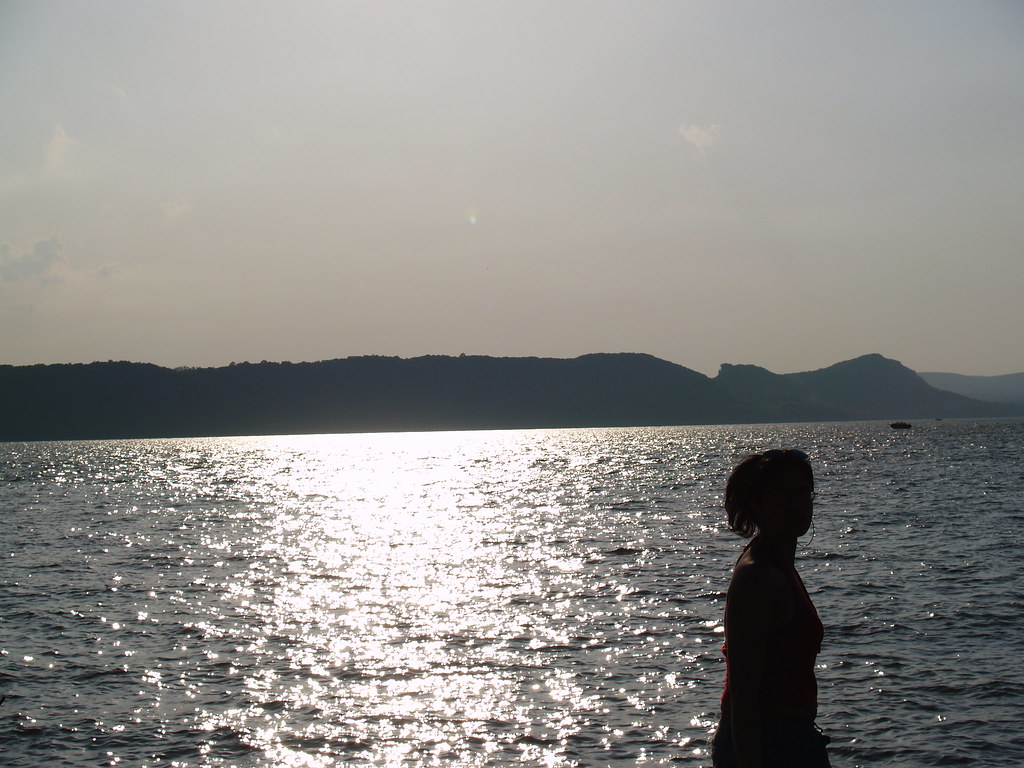
Selkirk skies.
Monday, August 20, 2007
splitting fruit

Washington Monument.
from my senior work, Get Away First.
D.C. day,
he takes me to Dupont Circle where speed chess games
went lightening quick and shopping carts wielded by
men in drag and women in garters and inside,
light and shadows intertwine on walls from
a simple glass hoop twirling in place,
awe.
D.C. night,
he looks at the trees and i look at the blackened
blue sky and air with hints of winter, we stand
closer together and when letters run out,
one syllable words take over as
street names. i insist there is
reason behind the names
and he says it's just
coincidence, by
chance.
we first familiarize ourselves
with me & you (we slip hands
together easily, there is something
that feels
comfortable
that feels
good)
we walk along Davenport to
Rock Creek Park where
we stroll in the
middle of the street and
disregard cars
we jump the tiny creek
and are surrounded by
tall almost bare trees with
baby green leaves sprouting
the sun made them lighter and
lower branches lash at my feet

Rock Creek Park.
we sit and we eat
pasta and sauce and raisins
amongst fallen trees (unpredictable
rain storms) and we
watch deer
watch us
watching them
we familiarize ourselves
with us walking through
Arlington Cemetery
looking at rows of
chalk-white gravestones
trying to interpret the meaning of
a cross within a circle and
why unknown graves didn’t have numbers
at the Tomb of the Unknown Solider,
we watch in silence a soldier hand off
a gun after inspection with sharp turns
and clicks of heels
we wander across the Potomac and
venture to the western National Mall where
children play in unknown smoke billowing from
a grate and a man in orange play
handball against the marble wall
we sit near the Monument
watching that wall and the flags
dim gold
into darkened dusk

National WWII Memorial.
Wednesday, August 15, 2007
Familiar and Unfamiliar Pasts

The name on my original birth certificate wasn't Nadia—it was
In The Namesake, Indian-American author Jhumpa Lahiri brings up good names: the name your family and close friends call you. When I read that, I was excited because I didn't know it actually existed—I just thought it was something my parents did. We called it our home names. My brother doesn't have one and my sister's is Nasha, just a slight modification.
My home name is Sharna (shor-na), Bengali for gold. I was the first born, so I was special. Answering to this name is second-nature to me.
***
I knew my parents were born in the 1950s in
Because of my new interests in that corner of the world (to be fleshed out at a later date), Jon recommended Salman Rushdie's
The perspective of the book is intriguing and refreshing because I don't get to see other Muslim Indian/Bengali perspectives. That’s also why Lahiri's works resonated with me. Despite her characters being Hindi, there were similarities. Though, with Lahiri, her characters usually immigrated to the
I never understood then-West
And it didn't.
After the Partition,
Religion is a powerful motivator. It was because of religion that the
My parents still hold prejudices against
Borders still aren't very clear in
But then, to balance that, test runs of the Moitree Express (Friendship Express) between Calcutta, India and Dhaka, Bangladesh were successful. The train service was shut down before because of wars and violence between the two

After Rushdie's book, my friend Hannah lent me Pankaj Mishra's The Romantics. After Rushdie's extraordinary novel, Mishra's is, at first, very slow paced and very subtle. He writes of Europeans collecting in
“A deep gorge appeared on our left, the river in it seeming to sneak shyly past all obstructions. The illusion was broken when, after we had been traveling for an hour down into the gorge, the river appeared roughly parallel to the road, and all the bus’s relentless grumbling and rasping and clanking could not muffle the thunderous boom of thick white jets of water pummeling the huge white rocks squatting in its way. Away from the angrily frothing river, the thinner, humbler streams flowed into small quivering pools on whose banks grew delicate irises.”
And he mentions Frooti, the delicious “cool mango drink,” so more points for him.
Amidst the celebrations, with good tidings,
***
While reading Rushdie and Mishra, I sounded out all of the foreign words and was surprised to find familiar words: accha (yes, okay), bas (enough), ek dum (always, complete), sabkuch ticktock hai (everything is okay), dekho (look), arré baapre baap (equivalent of oh my god, I think).
But there are differences.
Saleem's Ramazan is the same as my Ramadan and his Dacca, where he was surrounded by Bangladeshi independence as a wise and sullen Pakistani solider is the same as my Dhaka, where my parents grew up, where most of the Chaudhury/Begum families reside (with exceptions in Germany and Singapore/Australia).
At home, we communicate through a blend of Bengali and English. I understand Bengali (with bits of Urdu and Hindi) more than I can speak it. On phone calls back to Bangladesh, I accidentally speak in a hybrid of Spanish and Bengali, my mind tries to substitute English words for any foreign words it can find. When forced to think about it, I can't say a Bengali phrase. But I will say this: I am well-versed in Bengali curses.
Writing Bengali is a different story. While my parents write long letters with the beautiful scripts of Bengali, Arabic, Urdu, Hindi and so on, they aren't sure how to romanize their language. Writing emails to my mama (maternal uncle) and cousins are easy enough because we write in English, but some words are difficult to spell out and I, being the person that I am, want to make sure I'm spelling it correctly. My cousin once called us picchis which means little people, but I thought he meant picchas which means dirty or garbage.
I remember making my mom show me how to write "Nadia" in Bengali and I practiced it over and over again, connecting curving lines with a neat horizontal line on top. I can't do this now.
In both novels, the men wore lungis, what my dad changes into at home, this sheet of cloth he somehow folds onto his waist. It reminds me of saris, the mechanics of which I never fully understood either. When I have to dress up for Indian/Bengali events, I either wear salwar kameezes or lehengas adorned with loads of gold jewelry, even though I don’t like gold. I eat parathas and basmati, I drink chai.
Desh means country.
The Bengali national anthem is "Amar Shonar Bangla" ("My Golden Bangladesh").
There is so much about the area that I'm just beginning to learn about and hopefully, I will put this knowledge to good use...
Sunday, August 12, 2007
Baptism by Fire: An Interview with Justin Kirk
 Justin Kirk in front of The New School.
In honor of the Weeds season 3 premiere tomorrow (I've watched the first four episodes, and let me say that they are excellent), I am posting an interview I had with Justin Kirk (playing Andy Botwin, Nancy Botwin's pothead brother-in-law) back in November 2006 for Inprint. Although the main peg of the interview was his film Flannel Pajamas, I still managed to talk to him about Weeds.
Standing in front of The New School on a Monday afternoon, Emmy-nominated actor Justin Kirk looks just like a regular student—hair arranged messily, hands in his pockets, standing slightly hunched with a stylish rip in his jeans.
Kirk is probably best known for playing AIDs-stricken Prior Walter, whose boyfriend abandons him, in the HBO miniseries Angels in America and his part as the sex-obsessed, pot-smoking brother-in-law Andy Botwin in Showtime’s TV series Weeds—who, among other things, teaches his youngest nephew how to masturbate into a banana peel. Currently, he is promoting his newest film, director Jeff Lipsky’s Flannel Pajamas, the story of the rise and fall of a relationship. In person, Kirk is similar to his acting persona—unabashedly delivering smart, sarcastically tinged laugh lines, all the while exuding charm.
We begin the interview in the Gigantic Pictures’ downtown office. I tell him I’m majoring in poetry. “Nice, so this will be a very poetic interview,” he says. “Feel free to twist my words.”
Justin Kirk grew up in Washington state and attended elementary school on an Indian reservation—“I was just a kid, so I don’t have great sociological insight,” he says. Then he moved to Minneapolis, where he enrolled in the Children’s Theater School. From the beginning, Kirk says, he felt like he wanted to be an actor. At the age of 18, he moved to Los Angeles and then ended up in New York, where he did theater. Currently splitting his time between Los Angeles and New York (he comes back at least once a year for work), Kirk says he “loves Los Angeles for all the reasons you’re not supposed to like it. I’m a kind of person that doesn’t need to be doing stuff, so I don’t mind being stuck in traffic and staring. I’m sort of a daydreamer.”
“There’s something just really sweet to me about people from everywhere who have come to this place with their big dreams, and they’re going to roll the dice and it’s going to happen,” he says about LA. “And a lot of people find it depressing, but I think it’s kinda cute.” He laughs. “The difference is that in New York, life is thrust upon you. In Los Angeles, you have to search it out. I couldn’t leave my apartment [in New York] without running into some asshole that I knew, whereas in Los Angeles, you gotta have a destination, and you have to get in your car to go there.” But, he adds, “I find myself in New York a lot. You can’t get out. In the beginning, I was really burnt out [by the city], but each time I come, I realize I do miss it a lot.”
In Flannel Pajamas, Kirk plays Stuart, a man whose profession is to entice unknowing tourists to Broadway shows by fabricating elaborate stories. He embarks on a relationship with Nicole, played by Julianne Nicholson, the eager-to-please girlfriend with a slightly neurotic family. Stuart is “a guy who seems to have a plan for his life and in the world of relationships, [when] he meets Nicole,” Kirk explains. “He thinks [she] is pretty perfect for him and fits all the things he wants, and starts hammering her into the hole of that plan that he has.” The character, he adds, is “confident and also insecure. It’s sort of what actors are. A mix of egotism and insecurity.”

Justin Kirk as Andy Botwin in Weeds.
Kirk clears up one confusing aspect of the film: how Stuart and Nicole meet. It is, he says, not through their therapist (as most viewers are led to believe) but their dermatologist—a detail that greatly changes the audience’s perspective of the movie. “The question of why they were going to a dermatologist,” he jokes, “is equally important,” as to what hidden, psychological issues the characters might have.
He recalls his most famous role, in Angels in America, as “such an ordeal.” The play (Angels in America) was the play of my generation of New York actors,” he explains. “Actually, the first play I did on Broadway was across the street from Part Two [Perestroika] of Angels in America, and our play was not a huge hit, and they had huge lines.”
“It was a burden to say the least. The legacy the play already had when we started was immense, and then added to it was Meryl Streep and Al Pacino. There was no question that people would be watching it while we were making it, so that felt a little scary,” he says. “I’ve learned a lot from it, I will never have the same sort of fears and torture that I had making it, cause it was sort of like baptism by fire, which was a good thing.”
Kirk says he’s obsessed with with political television and blogs (especially during the months leading up to the elections) and with music. He sings a little bit of Wilco to me (“I know we don’t talk much”) and recommends The Replacements. As we leave the office and wait for the elevator, he asks me how I am getting back to school. The subway, I tell him.
“I can give you a lift,” he says. After looking for his driver and car, we are off, and that’s how Kirk winds up having his photo taken in front of The New School.
On Weeds:
"I feel really blessed to have that job. I worked with Mary Louise Parker in Angels in
"I think she [the writer] wrote that so Showtime could never get anyone else to, so they could never fire her, cause no one else would know how to get out of it. I don’t know what they’re going to do. I have an idea about some of the stuff, though."
And here's to another amazing season.
Thursday, August 9, 2007
Beware of Hello Kitty
Amidst insurgents and violence, an unstable government and the looming possibility of an election and new constitution, Thailand has figured out a new way to keep its police force in check: Hello Kitty armbands. Cops who commit minor infractions, such as coming to work late or littering, will have to don wide, pink armbands featuring Miss Hello Kitty herself peeking over a polka-dotted heart with her name elaborately displayed in pink cursive.
Pongpat Chayaphan, the acting chief of the Crime Suppression Division, told the NY Times: "This new twist is expected to make them feel guilt and shame and prevent them from repeating the offense, no matter how minor. Kitty is a cute icon for young girls. It’s not something macho police officers want covering their biceps.”
Now that's putting them in place! The Times also reported that Chayaphan tried plaid armbands at first, but it wasn't humiliating enough. I guess plaid was a bit too macho. Now, the question is, what happens to cops who follow the rules or those who, gasp, remove their lovely pink armbands? They don't have anything set in place but perhaps give them another armband, this time bearing Pochacco's figure. And what about those who go above and beyond? I think Badtz Maru is a worthy badge, I mean, just look at how bad-ass he is. He puts Hello Kitty in her place, that swaggering penguin.
Maybe Sanrio should just sponsor the Thai police force and design their uniforms. Hand in hand, Sanrio and the Thailand Police can fight crime and police-misdemeanors together.
Pongpat Chayaphan, the acting chief of the Crime Suppression Division, told the NY Times: "This new twist is expected to make them feel guilt and shame and prevent them from repeating the offense, no matter how minor. Kitty is a cute icon for young girls. It’s not something macho police officers want covering their biceps.”
Now that's putting them in place! The Times also reported that Chayaphan tried plaid armbands at first, but it wasn't humiliating enough. I guess plaid was a bit too macho. Now, the question is, what happens to cops who follow the rules or those who, gasp, remove their lovely pink armbands? They don't have anything set in place but perhaps give them another armband, this time bearing Pochacco's figure. And what about those who go above and beyond? I think Badtz Maru is a worthy badge, I mean, just look at how bad-ass he is. He puts Hello Kitty in her place, that swaggering penguin.
Maybe Sanrio should just sponsor the Thai police force and design their uniforms. Hand in hand, Sanrio and the Thailand Police can fight crime and police-misdemeanors together.
Monday, August 6, 2007
Ossining Wanderin'

Ossining (a.k.a. Ossining-on-the-Hudson).
Train up the Hudson where we rowed down to the city, the cliffs of the Palisades, New Jersey/New York, past Sing Sing Prison, the sort-of-Alcatraz of these parts with its layers of walls adorned with wires and bars, right by Louis Engel playground right by that Hudson where we discovered the SuperNova and gaggles of geese, this walkable, hilly suburban village-on-the-Hudson (named for appeal) where cars aren't out of place, coconut/lemon/raspberry talian ices at Vinnie's and talking about Mel Gibson taking over the world, Sabbath dinner outside, watching Scrabble games and reading the Times, looking for "On Language" and "The Ethicist," basement escapades, too-much-ice cream and lime sherbet, waterfront protection and Alaskan adventures with a second viewing of The Simpsons, chocolate milkshakes, dried mangoes, split personalities with Fight Club, fruit smoothies, a reintroduction to China via Crouching Tiger, Hidden Dragon, squeezing in Arrested Development, the most stars I've seen all year long, my introduction to the band of the Milky Way, night walk to triangle park, strolling around Maryknoll where we walked with deer and a bunny and walked through his elementary school days, early morning train rides home until next, next time...
Monday, July 23, 2007
The Cusp of Harry Potter
*May contain Harry Potter and the Deathly Hallows & Harry Potter and the Order of the Phoenix (film) spoilers. You've been warned.*

Welcome to Harry Potter Central (also known as Barnes and Noble at Union Square).
"And now, Harry, let us step out into the night and pursue that flighty temptress, adventure."
—Dumbledore in The Half-Blood Prince
It's difficult ending a series whether it be films, TV shows or in this case, books. Think of all the disappointing series finales. Take Sex and the City: big fuckin' deal, his name is John, wow. Compare that to Six Feet Under's beautiful series finale, which is hands-down the best finale I've ever seen. It is expected and unexpected at the same time, answers all of my questions from the entire series, doesn't get old and made me cry. Alan Ball knew what he was doing.
And in the same way, J.K. Rowling knew what she was doing with Harry Potter. From the amazing tale of a baby surviving the most notorious evil wizard's failed spell within a magical world where wizards and witches live along with Muggles (or, you know, non-magical people) and there is the fight between good (Dumbledore, Aurors, the Order of the Phoenix, Gryffindor and most of Hogwarts) and evil (Voldemort/You-Know-Who/Tom Riddle, Death Eaters), Rowling's story grew into a fully developed and wonderfully explored story and an enormous phenomenon, both for children and adults alike.
Because it was the last book, Josh, my sister and I decided to go all out and join the festivities at the Union Square Barnes and Noble after making a quick stop at Scholastic's blowout at Mercer and Prince Street where the mechanical Whomping Willow almost broke and a hand popped through one of its wailing branches.

Making wands at the wandshop.
There, as we were surrounded by people dressed up like Harry Potter, parents, a dog dressed up as a bat and random Harry Potter characters (my sister was terrified of the thestral), we drank potions at The Apothecary, made wands (where we waited near the travel section, thank god, and an adorable boy kept biting Josh), listened to Jim Dale read bits of Order of the Phoenix out loud, randomly ran into people that either of us knew (friends from college and my sister's elementary school friend), watching the press run around and get their interviews, videos and pictures, and just waiting, lots and lots of waiting. Because we didn't reserve the books ahead of time for gold wristbands (they didn't exactly advertise that, did they?), Josh waited in line that Friday morning and received a red wristband, which meant we would receive our books after all the lucky gold wristbanded people got theirs. And that meant we wandered around Barnes and Noble a lot.

Adorable little Remus Lupin.
After leaving the store at 2 a.m. and getting home at 3 a.m. I finished Harry Potter and the Deathly Hallows at 12 p.m. Saturday. After all the hype, it didn't even come close to being disappointing.
I don't want to spoil the book too much. The sixth book, Harry Potter and the Half-Blood Prince, was completely spoiled for me and to this day, I hate that person. But like I said earlier, with the exception of one chapter, this book was amazing. Rowling dished out the expected but it didn't seem too cheesy or predictable. There were flashbacks to earlier books and she even brought up minuscule details that didn't seem important at the time but here in the world of Deathly Hallows, everything depended on them. She explained all without letting the readers down. And while Harry Potter is ideally for kids, she threw in more mature developments, such as the eagerness at which Harry kisses. The battles are epic, especially the final showdown and Rowling shows no mercy with who ventures to the other side, whether they be a Death Eater or member of the Order of Phoenix. She also has a wonderful way of creating scenes. My favorite in this book, besides the battles, was the house on the cliff overlooking the ocean.

Counting down to midnight for the official book release.
Now, taking a step back, the week before, on July 10th, the three of us watched the midnight showing of Order of the Phoenix. Director David Yates (previously of mostly British television shows) took the reins from Alfonso Cuarón (HP and the Prisoner of Azkaban, Y tu mamá también) and created a brilliant film. Yates focuses completely on the larger picture—the question of what is behind the door that Harry (Daniel Radcliffe, who is incredibly attractive and looks older than he actually is and is legal as of today so it's okay for me to say that) dreams of as he enters Voldemort's mind and everything that leads up to it: Dumbledore's Army, the Order of the Phoenix, being reunited with his godfather, Sirius Black (the wonderful Gary Oldman). Though I did wonder how Cuarón would have approached the dark halls of the Ministry of Magic's Department of Mysteries.

The Whomping Willow at SoHo.
I could have done without Harry's and Cho's awkward and near-romance. Yates also created more implications within the film than they were in the movie, which isn't a good thing. As Sirius and Harry duel Death Eaters, Sirius outrightly calls Harry James, the name of Harry's dead father and Sirius' best friend, thus not subtly showing that that Sirius viewed Harry as a James-substitute. And there were far more longing-/loving-glances at hopeful-significant others. Other than that, Order of the Phoenix ties with Mike Newell's Goblet of Fire (which happens to be one of my favorite Harry Potter books, along with Deathly Hallows now). Whoever directs the final movie must do an excellent job, especially with the epic battle.

The line outside of the Union Square Barnes and Noble. Sadly, those people couldn't buy the book because they closed the store after all the red-wrist-banded people got theirs. My friend, who was waiting on that line at first, walked over to the 22nd and 6th Avenue Barnes and Noble and got his book at 1 pm. Yeah.
And now that the tales of Harry Potter are over, there's nothing left to do but go back and reread the books, starting from The Sorcerer's Stone (or, if you prefer, The Philosopher's Stone) and look for all the details I previously missed and just wonder if Equus is really coming to Broadway.

Welcome to Harry Potter Central (also known as Barnes and Noble at Union Square).
"And now, Harry, let us step out into the night and pursue that flighty temptress, adventure."
—Dumbledore in The Half-Blood Prince
It's difficult ending a series whether it be films, TV shows or in this case, books. Think of all the disappointing series finales. Take Sex and the City: big fuckin' deal, his name is John, wow. Compare that to Six Feet Under's beautiful series finale, which is hands-down the best finale I've ever seen. It is expected and unexpected at the same time, answers all of my questions from the entire series, doesn't get old and made me cry. Alan Ball knew what he was doing.
And in the same way, J.K. Rowling knew what she was doing with Harry Potter. From the amazing tale of a baby surviving the most notorious evil wizard's failed spell within a magical world where wizards and witches live along with Muggles (or, you know, non-magical people) and there is the fight between good (Dumbledore, Aurors, the Order of the Phoenix, Gryffindor and most of Hogwarts) and evil (Voldemort/You-Know-Who/Tom Riddle, Death Eaters), Rowling's story grew into a fully developed and wonderfully explored story and an enormous phenomenon, both for children and adults alike.
Because it was the last book, Josh, my sister and I decided to go all out and join the festivities at the Union Square Barnes and Noble after making a quick stop at Scholastic's blowout at Mercer and Prince Street where the mechanical Whomping Willow almost broke and a hand popped through one of its wailing branches.

Making wands at the wandshop.
There, as we were surrounded by people dressed up like Harry Potter, parents, a dog dressed up as a bat and random Harry Potter characters (my sister was terrified of the thestral), we drank potions at The Apothecary, made wands (where we waited near the travel section, thank god, and an adorable boy kept biting Josh), listened to Jim Dale read bits of Order of the Phoenix out loud, randomly ran into people that either of us knew (friends from college and my sister's elementary school friend), watching the press run around and get their interviews, videos and pictures, and just waiting, lots and lots of waiting. Because we didn't reserve the books ahead of time for gold wristbands (they didn't exactly advertise that, did they?), Josh waited in line that Friday morning and received a red wristband, which meant we would receive our books after all the lucky gold wristbanded people got theirs. And that meant we wandered around Barnes and Noble a lot.

Adorable little Remus Lupin.
After leaving the store at 2 a.m. and getting home at 3 a.m. I finished Harry Potter and the Deathly Hallows at 12 p.m. Saturday. After all the hype, it didn't even come close to being disappointing.
I don't want to spoil the book too much. The sixth book, Harry Potter and the Half-Blood Prince, was completely spoiled for me and to this day, I hate that person. But like I said earlier, with the exception of one chapter, this book was amazing. Rowling dished out the expected but it didn't seem too cheesy or predictable. There were flashbacks to earlier books and she even brought up minuscule details that didn't seem important at the time but here in the world of Deathly Hallows, everything depended on them. She explained all without letting the readers down. And while Harry Potter is ideally for kids, she threw in more mature developments, such as the eagerness at which Harry kisses. The battles are epic, especially the final showdown and Rowling shows no mercy with who ventures to the other side, whether they be a Death Eater or member of the Order of Phoenix. She also has a wonderful way of creating scenes. My favorite in this book, besides the battles, was the house on the cliff overlooking the ocean.

Counting down to midnight for the official book release.
Now, taking a step back, the week before, on July 10th, the three of us watched the midnight showing of Order of the Phoenix. Director David Yates (previously of mostly British television shows) took the reins from Alfonso Cuarón (HP and the Prisoner of Azkaban, Y tu mamá también) and created a brilliant film. Yates focuses completely on the larger picture—the question of what is behind the door that Harry (Daniel Radcliffe, who is incredibly attractive and looks older than he actually is and is legal as of today so it's okay for me to say that) dreams of as he enters Voldemort's mind and everything that leads up to it: Dumbledore's Army, the Order of the Phoenix, being reunited with his godfather, Sirius Black (the wonderful Gary Oldman). Though I did wonder how Cuarón would have approached the dark halls of the Ministry of Magic's Department of Mysteries.

The Whomping Willow at SoHo.
I could have done without Harry's and Cho's awkward and near-romance. Yates also created more implications within the film than they were in the movie, which isn't a good thing. As Sirius and Harry duel Death Eaters, Sirius outrightly calls Harry James, the name of Harry's dead father and Sirius' best friend, thus not subtly showing that that Sirius viewed Harry as a James-substitute. And there were far more longing-/loving-glances at hopeful-significant others. Other than that, Order of the Phoenix ties with Mike Newell's Goblet of Fire (which happens to be one of my favorite Harry Potter books, along with Deathly Hallows now). Whoever directs the final movie must do an excellent job, especially with the epic battle.

The line outside of the Union Square Barnes and Noble. Sadly, those people couldn't buy the book because they closed the store after all the red-wrist-banded people got theirs. My friend, who was waiting on that line at first, walked over to the 22nd and 6th Avenue Barnes and Noble and got his book at 1 pm. Yeah.
And now that the tales of Harry Potter are over, there's nothing left to do but go back and reread the books, starting from The Sorcerer's Stone (or, if you prefer, The Philosopher's Stone) and look for all the details I previously missed and just wonder if Equus is really coming to Broadway.
Monday, July 16, 2007
Dreaming of the Surface of the Sun
**contains spoilers for Sunshine, so, if you don't wanna ruin the movie, then, don't read.**

Clliff Curtis as Searle in the viewing room of the Icarus. Photo from Fox Searchlight Pictures.
With hints of Space Odessey: 2001, director Danny Boyle masterfully tells and shows the story in Sunshine of the mission of Icarus II, the space crew sent to save the dying Sun by creating another star within it. Seven years prior, the first crew of Icarus I failed to do so.
He reluctantly uses to create effects that he himself cannot, but as he tells the New York Times, he tries his best to stick to real images as possible. He didn't want to create a fantastically world—he is simply depicting space. And he does, wonderfully. What stands out about Sunshine isn't really the plot, it is how the story is told,
Icarus II finds the lost Icarus I on Mercury. The crew decides to see what is left and what could be saved. On board, they find the captain's, Pinbacker (Mark Strong) last recording. With no more hope, Pinbacker rants about death, control of death and God through jumpy, digitized views where we are shown glimpses of his horridly disfigured face. Then Harvey (Troy Garity), second-in-command of Icarus II, stumbles upon their bodies, slumped over one another in front of the filter.
They died basking in the Sun.
Boyle depicts this beautifully and quickly—their bodies are gray silhouettes against swirling gray dust. Their deaths are explained by a quick glimpse at the darkly framed filter, its center pure white.
Before this, Icarus II's captain, Kaneda (Hiroyuki Sanada), clad in a glittery gold spacesuit, is engulfed by the sheer strength of the Sun's rays while trying to fix damaged Searle (Cliff Curtis) begs him to describe what it is like, staring and being in the sun, but he does not answer. He just allows himself to be consumed by its heat and then it is over. The music emphasizes this moment even further, the steady loud thudding beats of drums race both hearts and minds.
In fact, Boyle and Underworld create a beautifully epic soundtrack, complete with reverberated sounds and sweeping strings mixed with the delicate yet strong stepping notes of piano.
Searle tells Capa (Cillian Murphy) "We're only stardust," and with Sunshine, Boyle and screenwriter Alex Garland, offers a gorgeous new insight into a possible future.

Cillian Murphy, as Capa, worked well as the hopeful and ideal-in-a-twisted-way physicist on the Icarus with his brilliant eyes, scraggly long hair, hints of his Irish accent and of course, his acting. Photo from Fox Searchlight Pictures.

Clliff Curtis as Searle in the viewing room of the Icarus. Photo from Fox Searchlight Pictures.
With hints of Space Odessey: 2001, director Danny Boyle masterfully tells and shows the story in Sunshine of the mission of Icarus II, the space crew sent to save the dying Sun by creating another star within it. Seven years prior, the first crew of Icarus I failed to do so.
He reluctantly uses to create effects that he himself cannot, but as he tells the New York Times, he tries his best to stick to real images as possible. He didn't want to create a fantastically world—he is simply depicting space. And he does, wonderfully. What stands out about Sunshine isn't really the plot, it is how the story is told,
Icarus II finds the lost Icarus I on Mercury. The crew decides to see what is left and what could be saved. On board, they find the captain's, Pinbacker (Mark Strong) last recording. With no more hope, Pinbacker rants about death, control of death and God through jumpy, digitized views where we are shown glimpses of his horridly disfigured face. Then Harvey (Troy Garity), second-in-command of Icarus II, stumbles upon their bodies, slumped over one another in front of the filter.
They died basking in the Sun.
Boyle depicts this beautifully and quickly—their bodies are gray silhouettes against swirling gray dust. Their deaths are explained by a quick glimpse at the darkly framed filter, its center pure white.
Before this, Icarus II's captain, Kaneda (Hiroyuki Sanada), clad in a glittery gold spacesuit, is engulfed by the sheer strength of the Sun's rays while trying to fix damaged Searle (Cliff Curtis) begs him to describe what it is like, staring and being in the sun, but he does not answer. He just allows himself to be consumed by its heat and then it is over. The music emphasizes this moment even further, the steady loud thudding beats of drums race both hearts and minds.
In fact, Boyle and Underworld create a beautifully epic soundtrack, complete with reverberated sounds and sweeping strings mixed with the delicate yet strong stepping notes of piano.
Searle tells Capa (Cillian Murphy) "We're only stardust," and with Sunshine, Boyle and screenwriter Alex Garland, offers a gorgeous new insight into a possible future.

Cillian Murphy, as Capa, worked well as the hopeful and ideal-in-a-twisted-way physicist on the Icarus with his brilliant eyes, scraggly long hair, hints of his Irish accent and of course, his acting. Photo from Fox Searchlight Pictures.
Thursday, July 12, 2007
Working at The Brooklyn Rail

Inside the Brooklyn Rail office.
Officially, I am now a (working) member of The Brooklyn Rail, complete with press pass and title (Layout Editor soon to be Art Director). Prompted by my graduation anxiety in May, I sent out my resume in a flurry to a list of contacts provided to me by a wonderful adviser at Lang. The editor of the Rail responded and I met up with him. We got along well and that's how I came to assist at the Brooklyn Rail. This was without pay because no one really gets paid but I wanted to stay involved with a publication. The environment is fun and lax, everyone is chill and interesting and it was perfect. My first day there (I proofread printouts), one of the designers mentioned how they needed to find more designers, since they were going to leave soon. Being in the right place at the right time, I mentioned I designed for my college newspaper and I knew InDesign pretty well. And from that, I became a layout editor. You can see my handy work in this month's issue of the Brooklyn Rail, adorned with either a Jesus toy figure on a fighter jet or a photograph of a Richard Serra piece on the covers, within the Local, Express and Streets sections.
Subscribe to:
Posts (Atom)