Showing posts with label Rivers. Show all posts

Monday, April 28, 2008

Wednesday, March 5, 2008

Bits: Alt+Ctrl+Delete & More About Israel & Palestine, Owning an Island, Owning (a Portion of) a River and Chinese Ramadan


On the Palestinian side of the West Bank Wall, photo by filippo minelli

1.

"A compendium of geek graffiti" by Daniel Terdiman, from geek gestalt via cnet.com

I gotta say, I really like that.

2.

"Your Own Private Island" by Kristina Dell, from Time

I gotta say, it sounds pretty tempting--owning your own island? If only I was rich...oh the things I could do. But then again, that's as bad as private waterfront, right?

3.

"Georgia Claims a Sliver of the Tennessee River" by Shaila Dewan, from New York Times

Once more I will say this: that's the kind of articles I'd love to write, but with a more international-spin to em. And the article's well-written, too.

One of the cover stories of the New York Times Magazines sometime late last year concerned the water drought in the West and how it's a big deal. (The pictures were gorgeous too and await adorning my room, somehow...). That's one of the reasons Georgia wants to claim that part of the Tennesee River as their own. And another reason as to why this story caught my attention: the idea of defining borders and ownership. And, I'm sure, it's about pride and defining and broadening Georgia. Bigger is better, right?

And awesome quote:
"Mayor Ron Littlefield of Chattanooga, Tenn., said he was disappointed that [Georgia State Senator David J.] Shafer did not seem to be having the fun that the mayor sees as one of the joys of Southern politics. 'I saw him grumbling that we didn't seem to be taking it seriously," Mr. Littlefield said. "Well, I'm sorry, we're not.'"

4.

"Dispatches from China's Wild West: Ramadan in China" by Joshua Kucera, from Slate

I thought this Ramadan article was kinda late...isn't Ramadan held during a somewhat universal time (I know Saudi Arabia's and I believe the U.S.'s start within a day apart and end the same way, depending on the moon or something)? Or maybe he wrote the article earlier...

Anyway, I really, really like Slate's foreign Dispatches feature, because they actually cover interesting, varied topics. I found an entire series for Bangladesh, which made me happy. And that's something else I'd be interested in.

And it's fascinating, the whole the blend of two cultures, or rather, the attempts of co-existence between two cultures, in this case a more Arabic and then the Chinese culture.

5.

"Mourning tents spread on Gaza Strip" by Ed O'Loughlin from The Age

And this kinda made me tear, especially his quote, because you know it rings true with people from both Palestine and Israel, yet no one hears their voices and they're the ones suffering.

6.

"Israel closes charities in West Bank" from Press TV

But. It's not their land. How does Israel have the right to do that? What the hell?

7.

"Impossible Travel" from KABOBfest

A long, long, long list of travel restrictions for Palestinians/Gazans/West Bankers (is that correct?) within the Israel/West Bank/Gaza area.

8.

"Israelis, Arabs Join to Save Wildlife" by Lauri Copans, from AP

That is pretty damn awesome, working together and for a good cause.

Tuesday, February 19, 2008

Stuff of Fantasy


The early stages of the Quixotic last year.

Last Friday, I dropped by the boat shop and heard Adam Green, the founder and Executive Director of Rocking the Boat, a Bronx-based boat building and rowing program aimed at New York City youth. After showing a video about their programs, Green talked about how they build their boats (they go into the woods and cut down a tree, which is fucking awesome) and rowing in the Bronx River (something I need to do still). Then it was onto the Q&A.

Someone asked Green how he got pulled into he world of boats and the water.

"Boats are the stuff of fantasy," he answered. He went on to talk about how people feel there is a barrier between land and water and how he wants to get rid of that feeling. What a great quote.

Rowing in the Naf River


This was taken during our boat ride to St. Martin's Island, off the coast of Bangladesh. The Naf River acts as the border between Burma and Bangladesh.

Saturday, February 9, 2008

The Living River


"...The living river and the living river alone gives coherence and significance and therefore beauty to the canyon world. 'I love all things which flow,' said the deepest of Irishmen."

--Edward Abbey, Desert Solitaire

Friday, January 25, 2008

Water, Water, Filthy Water


Look at all that water flowing into one of the rivers of Dhaka.

When my family and I went to Bangladesh back in 1995, we weren't as cautious about what we ate and drank as we should've. Remember, Bangladesh is a still-developing country, and its water system isn't exactly all that great. So, we all got very sick at various times, being shuttled back and forth between various doctors because our immune system, to used to the American way, couldn't handle the Bengali way.

This time, my dad, after making sure we all had our shots, made sure that we drank nothing but either bottled water that we could trust (because who knows what people put in bottles, slap a label on it and call it "safe") and cooled, boiled water. Our dishes were even washed in boiled water and we didn't drink water at other peoples' houses if they didn't know our requirements.

I talked to Rob about this yesterday and he told me about the first time he visited Pakistan. He went with two "germaphobes" (his word), a doctor and someone else I can't remember right now. They'd wash their hands and scrub down everything, in fears of catching something horrible. This got on Rob's nerves so one day while they were eating in a restaurant, Rob ordered an entire pitcher of tap water and drank it by himself. He was later rewarded with amoebic dysentery.


Imagine drinking that.

Wednesday, January 2, 2008

In Bangladesh

We flew over Iran at night and outside, I saw scattered clumps of light. Then, I saw the sun rise over the blackened outlines of sand dunes and/or mountains (not sure which), the horizon lined bright bright orange. I wanted to be down there so bad.

Bangladesh is crowded.

My dad says human life here has no value and it shows: kids and people walk and run haphazardly across streets with no lanes nor stop lights, streets filled with cars, rickshaws, baby taxis, buses and just other people. The air is constantly thick with exhaust, dust and other assorted goods.

Development is booming here--there are billboards boasting of luxury apartment buildings and new storefronts everywhere. Homes are everywhere. There are buildings in unfinished states, their pillars standing alone, supporting nothing at all.

It's different from what I remember.

Even my father's home is different--instead of the expansive one-story floor, with many rooms and the roof where I kept a secret hiding place, it is now one-half of that home, the other half another aprtment for another family, and on top, there are more apartments.

It's disappointing.

In lighter news, I did get to go on a boat ride with my cousins. The river was nice (I forgot the name, but I'll get it later), and the boat was low. It was perfect.

It's unnerving how much people stare. I don't know if it's because it's normal to stare or because it's so obvious that I'm American, but it's hard to get used to. When I travel in the summer, I'm going to wear salwar kameezes because it's just easier that way.

I'm at my cousin's place right now--the only place I've been to that has internet. There is more I want to say and show, but I don't have my pictures or notebook with me now. I'll save that for next time.

Till then.

Saturday, December 22, 2007

Berger's New York: A Frozen Hudson

Remember in The Day After Tomorrow where people walked on the Hudson and through the mouth of the harbor in search of someplace warmer? Yeah, and how you also thought that couldn't happen in real life because of the salinity of the Hudson? According to Meyer Berger's column, the Hudson used to freeze over all the time:

***

January 19, 1955

A group of middle-aged gentlemen in town got talking about the weather the other day and how modern winters are sissy periods compared with those they passed through in youth.

One stubborn fellow insisted that in 1918, when World War I was on, he and a whole group of small-fry from Ninetieth Street walked across the frozen Hudson to a point on the New Jersey shore--Fort Lee he thought it was.

The talk swelled to uproar at the bar, one faction holding that there has been no bank-to-bank freeze below Yonkers in modern times, though such a phenomenon was common in the seventeenth, eighteenth and nineteenth centuries.

Newspaper files show that a munitions worker named Fred Gabay crossed on the ice from Hastings in Westchester to a point on the New Jersey side in a free-up on Jan. 2, 1918. The same file indicated a Hudson River freeze-up just five years earlier but didn't say how far down it came.

The files also showed a photograph, published Jan. 13, 1918, showing Dr. Lee de Forest, the inventor, and Miss Nancy Mayo crossing the Hudson opposite 230th Street, New York City.

Edward Rindwood Hewitt of Gramercy Square, son of Abram Hewitt, who was Mayor of New York in 1887, remembers that the Hudson froze almost every year around that period, mostly about February.

It sticks in his mind, he says, because he and the other silk-stocking kids used to sail-skate from somewhere around Yonkers down to Manhattan's upper reaches. They did it year after year.

Mr. Hewitt, pushing 90 down, recalls clearly that one winter day in 1875 it was the East River that froze, and probably both rivers. That freeze is fixed in his memory because the cash boy for his grandfather, Peter Cooper, due at the office in Water Street that morning, didn't show up until mid-afternoon.

It turned out that ice had stopped the East Twenty-third Street-Greenpoint ferry, so the cash boy had come down the hard way. He had walked from Cooper's Bushwick glue factory to Greenpoint, then to the Manhattan shore and all the way downtown without wetting his feet.

The last ice-up anyone could remember was during the record cold of February, 1934, a bitter depression year when the thermometer only once struggled above freezing. By that time, though, river traffic was so heavy that there was no shore-to-shore ice bridge, only heavy floe accumulation.

***

That would've been so amazing to see. I need to get over to the Hudson when it snows, because I've never seen it like that before.

Tuesday, December 11, 2007

The Outside World


The combination of watching Stand by Me at Kayley's a while back and taking the train between Cold Spring and Beacon, retracing our walking adventure around Dennings Point made me miss camping. I wish it wasn't so cold outside so we could wander the woods with a hand-drawn map again.

Josh and I went back to Selkirk a couple of weekends ago. For the sake of adventures, we decided to go visit Kaaterskill Falls, after deciding not to hike the Catskills for our lack of ice gear as Rob suggested we bring. After getting lost and being misdirected quite a bit, we finally found the stream from Kaaterskill Falls, but no actual waterfall. We parked the car in a little offset from the road, climbed over the railing and and slid our way towards the water. What fascinated me were the icicles. I wished it were summer because I know the water would've felt nice. We jumped from rock to rock, trying to get as far up as we could. Then we went back and warmed up in the car. Despite the cold, it was fun and something I needed.


Recently, I looked through my rowing pictures and I realized how much I missed it. Once spring rolls around, I plan to fully utilize the warm weather and everything I learned from the past year: camping, hiking, rowing, just about everything.

I want to explore Bannerman's Island, however illegal it might be. Rob and I talked about this during dinner at his house last weekend and he said that we couldn't use a Whitehall; we'd have to take a smaller boat, like a kayak, but that doesn't allow for many people. I need to think of something else. Or some way to work around that...

In the meantime, I'll dream of faraway tropical places and New York in the spring.

Monday, December 3, 2007

Early Morning New York Harbor

I don't really feel like writing today, but I just wanted to share this gorgeous photo I stumbled upon by way of Gothamist (who also featured some of my photos, woohoo):

[Photo by Matt Semel, via flickr]


The little island to the left is Liberty Island. New Jersey is in the foreground, with Brooklyn on the left and Staten Island on the right. That bridge right there is the Verrazano Bridge. Here, the Hudson River feeds into the Atlantic Ocean, which stretches on and on in this picture. All those little black spots on the water are boats and barges. How wonderful.

Wednesday, November 21, 2007

Words of a Song

Most people were born with music--their parents listen to albums over and over again and thereby instilling the same songs in their children. So they grew up knowing who the Beatles and Billie Holiday were, from their parents and older siblings. For me, this wasn't the case. My parents moved here from Saudi Arabia in 1984. They had their own music: Bengali and Indian folk and pop songs, most featuring the strums and plunks of the harmonium.

That was the my background music of my childhood, but it was never the focus of it. Every Sunday, our "home" days, as we called them, my parents relaxed in their room, listening to their music. My brother, sister and I stayed in the living room, watching TV shows.

So the point is, I had no grounding in American music. I was familiar with television because my father made sure I had that special American privilege, but music? They knew nothing at all.

Eventually, I caught on, catching music videos on TV, listening to the radio and then to my major source of music: friends' recommendations and the wonderful world of the Internet.

While listening to my iPod recently at work, I thought about why certain songs caught my attention. There are specific subjects and words that captivate me, and when I can find them in a song, it makes the song just that much better.

- maps

Wilco's "You Are My Face"

I have no idea how this happened
All of my maps have been overthrown

Wilco's "A Magazine Called Sunset"

Let's take a map across your pillow
And breathe the sky in through your window
I'll stay in the riddle and watch your books cave in

- the water/rivers/boats/oceans/anything else water-related

Decemberists' "The Island, Come and See, The Landlord's Daughter, You'll Not Feel the Drowning"

There's a harbor lost within the reeds
A jetty caught in the overhanging trees
Among the bones of cormorants
No boot-mark here nor fingerprints
The rivers roll down to a soundless sea

Wilco's "On and On and On"

Please don't cry, we're designed to die
You can't deny even the gentlest tide

(I love the way Tweedy sings "gentlest")

- traveling

Modest Mouse's "The World At Large"

The days get shorter and the nights get cold
I like the autumn but this place is getting old
I pack up my belongings and I head for the coast
It might not be a lot but I feel like I'm making the most
The day's get longer and the nights smell green
I guess it's not surprising but it's spring and I should leave

- stars

Oasis' "The Importance of Being Idle"

I don't mind
As long as there's a bed beneath the stars that shine

Bob Dylan's "Desolation Row'

Now the moon is almost hidden
The stars are beginning to hide

- some sort of act of defiance

Decemberists' "And Here I Dreamt I was an Architect"

And we are vagabonds
We travel without seatbelts on
We live this close to death

- about other places

Arcade Fire's "Cold Wind"

If you're going to San Francisco
Lay some flowers on the gravestone

Spoon's "Chicago at Night"

But then she'd never been to Chicago at night before the fall
And it don't stop, not at all

Sufjan Steven's "Chicago"

Drove to Chicago
All things know, all things know
We sold out clothes to the state
I don't mind, I don't mind
I made a lot of mistakes
In my mind, in my mind

- about the city and New York in particular

Wilco's "Jesus, Etc."

Voices whine
Skyscrapers are scraping together

- dreams

Wilco's "Dreamer in my Dreams"

There's a dreamer in my dreams
Swinging from the beams
With a light shining off the lake

These examples, it must be noted, reflect my current listening habits, therefore certain artists appear more than once, like Wilco. I have to say, though, it's impressive that I still listen to Wilco because I usually tire of an artist after three months. Thank you, Chicago boy.

Friday, November 16, 2007

Touching the River


My beautiful boat at entirely accessible and regular rowing destination Maxwell House Beach in Hoboken, New Jersey.

The view from Roosevelt Island is gorgeous—midtown Manhattan just across the way, the 59th Street Bridge, the tram and the rushing East River. This is New York City at its finest. Sitting on the steps before this panaroma is awe-striking, the juxtaposition of the urban with the natural. But there is more to this scene than just pretty pictures. Dividing the city and the river are railings, lots and lots of railings. There is a sense of detachment. You can look, but you can't touch and all I want to do is feel the water beneath my feet.

There are no railings up in Selkirk, Poughkeepsie and Ossining. I could walk over to the Hudson, sit on some rocks and feel the waves lap on my legs. The coolness of the water touching my skin was soothing.

Where are these places in New York City? Thinking about it, there are barely any. Rob has a website (not sure if he updates it now) all about New York City beaches. There are a few, such as Valentino Pier in Red Hook and Hallets Cove in Long Island City, but it feels like there should be more.

There are pushes for more access, though.

According to New York Construction (which I stumbled upon by way of goingcoastal), the city, working with other agencies, is building an extension of Harlem River Park, from 139th to 142 Street. Wonderfully enough, this is one of the few, if only, parks in New York City that allow for actual water contact:

"...offer[s] visitors...water access-points that will allow people to dip their feet in the water and load canoes and kayaks."

Rowing in the Harlem River is completely different from rowing in the Hudson and East Rivers. Up there, you're less susceptible to currents and, at least for me, it's an area I don't know too well, so the views are gorgeous.

And then you have plans like for the East River Esplanade where there is no interaction with the water; the same goes for most of the proposed plans for my beloved Pier 40.

We don't need more retail space—New York is already filled with that. We don't need another Seaport. Forget all the barriers. What we need is a return to simplier, natural things, like accessible shores.

Wednesday, November 7, 2007

Bits: Staten Island's Marshlands, Turkey & Kurdistan, Takes on Pakistan's Martial Law, Gay Muslims and the SF Mayoral Race

1.

"Protecting a Wild Patch of City Marshland" by Andy Newman, from the New York Times

"This is a window into what Staten Island used to be," he said. "And here it still is."

Just from reading this article, I have the strongest urge to go and see what's there. I have that and the Rossville Boatyard to check out.

2.

"The Turks Are Coming! Oh, They're Already Here" by Andrew Lee Butters, from Time

He was describing the Turkish camps along the Turkish-Iraqi/Kurd border and this line was just too good (and I'm a sucker for anything with rivers):

"One camp that's home to some 300 fighters in a ravine carved by the cold blue waters of the lower Khabour river looked like a beautiful place for an invading army to die."

3.

"Musharraf's Martial Plan" by Benzair Bhutto, from the New York Times

I disagree with Bhutto's lede ("Nov. 3, 2007...as the blackest day in Pakistani history;") I think I can think of several other moments that are worthy of that distinction. Otherwise, I agree with everything else she says and especially like how she called the U.S. out in the end. Let's see, though, what she does on Friday. She already tried to negotiate with Musharraf before and it went nowhere. I hope she knows not to make the same mistake again.

4.

"Mushy: Handsome in Uniform" by Maureen Dowd, from the New York Times

Normally, I don't like Dowd's style. Sure, what she has to say is true, but she tries too hard to be clever. Today, though, she made some great points:

"America's influence is not unlimited. And unfortunately for the oppressed, Mushy's open defiance is helping to further undermine America's influence. But we will use what influence we have left to pretend that jailed dissidents prefer their chains and that human beings aspire to live at the mercy of bullies."

"All who live in tyranny and hopelessness can know: the United States will ignore your oppression and excuse your oppressors. When you stand for your liberty, we will not stand with you."

"In the long run, there is justice without freedom, and there can be human rights once the human rights activists have been thrown in the pokey." [That reminds me of the situation in Burma.]

5.

"Pakistan's General Anarchy" by Mohammed Hanif, from the New York Times

A former member of the Pakistani Air Force Academy wrote about the power of and the rise of Islam within the Pakistani military:

"Only last month, Pakistan's Navy, in an audacious move, set up a barbecue business on the banks of the Indus River about 400 miles away from the Arabian Sea it's supposed to protect.

"It's a happy marriage between God and greed.

"For now, the general's weekend gamble seems to have paid off. From Washington and the European Union, he heard regrets but no condemnation with teeth—exactly what he counted on.

"General Musharraf has always tried to cultivate an impression in the West that he is the only one holding the country together, that after him, we can only expect anarchy. But in a country where arts teachers and lawyers are behind bars and suicide bombers are allowed to go free, we definitely need to redefine anarchy."

6.

"Gay Muslims Find Freedom, of a Sort, in the U.S." by Neil MacFarquhar, from the New York Times

Something I've never thought about until recently.

7.

"San Francisco Mayor's Race Offers Drama, but No Suspense" by Karl Vick, from the Washington Post

I sent this article to Sean with the subject: 'this is partly why i love san francisco,' and it's true. Gavin Newsom, the incumbent cheating hearthrob of a mayor, isn't the star of the race--he has to compete with a nudist, homeless taxi driver named Grasshopper, sex club owner, a previously jailed blogger (Josh Wolf, who refused to show video footage of protests), and more.

The idea, according to Quintin Mecke, another mayoral candidate, is:

"After seven years of Republican rule, we want to be as far left as possible, because we have tilted so far to the right that moderation is not going to get us anywhere near balance."

Tuesday, November 6, 2007

Bangladesh By River & My Life

By way of a Google alert I had for Bangladesh, I found this announcement on BBC. Journalists from the BBC will travel on the MV Aboshor around Bangladesh by its many rivers in order to observe how climate affects the banks and in turn, the people. Bangladesh relies on its rivers, but at the same time, the drastic weather changes wreck complete havoc on the country, as seen during the past summer.

Reading through the various journalists' articles (on a sort-of difficult website to navigate) and a comment Rob made earlier, I've come to realize what kind of career path I ideally want to tread on—traveling around and writing about the things I'm interested in, like boating along Bengali rivers, press rights in Burma or waterfront access in New York. This is something I need to get started on soon.

Sunday, November 4, 2007

Camping at Denning's Point


Beautiful sunset-colored views from Denning's Point.

Since I've been camping with experienced campers and I've been wanting to get away, I decided to take charge and organize my own trip. After getting three other people—Josh, Sarah and Tyler—to come along and picking our location and game plan—Denning's Point by way of the MetroNorth and walking—and we were off.

Originally, I had planned to catch the 8:51 a.m. train out of Grand Central Saturday morning, but after Josh reminded me about the party we were attending the night before, I changed my mind. Sarah, Josh and I met at the clock at Grand Central at noon, with plans to catch the 12:51 p.m. train out to Beacon. Tyler, who was running late, just made the train. The trip was off to a perfect start.


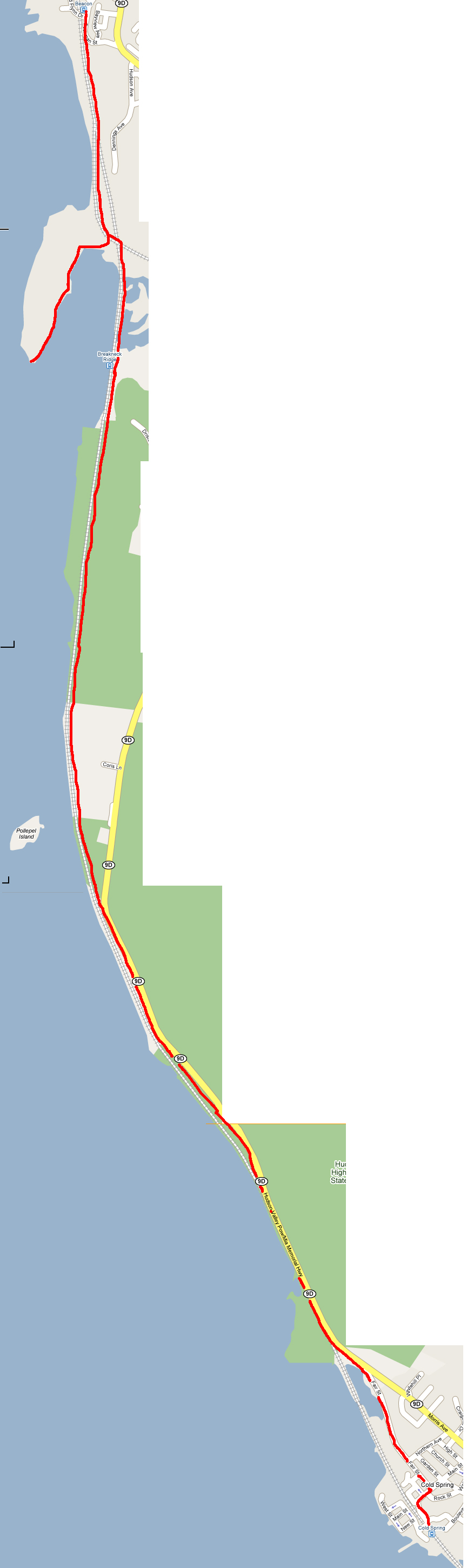
The way to Denning's Point.

Arriving at Cold Spring at 2:15, we exited the station and looked for the best way onto the tracks without attracting too much attention to ourselves. Reaching the end of the parking lot, we slipped through the end of the fence and walked through brush until we reached the open space of the MetroNorth railroad tracks. We followed the main tracks and then continued onto what seemed to be an abandoned line that headed to our right.


Making our way to the Hudson.

All I had to direct me was the map Rob drew for me, pointing out how to get to Denning's Point via railroad tracks and where our proposed campsites and a creek lined with abandoned factories. Somehow, we made it to Denning's Point, with a sign about no winter camping greeting us. Making a left, we found ourselves off the trail and along the coast. Though the views were gorgeous, we had to duck through low branches with huge bags and step gingerly on slippery rocks. After walking this way for a while, we finally reached our camp site. Granted, it was the second of the two Rob pointed out to us, but this site was better because it avoided the wind.


The view from our campsite.

Looking across, we could see the flat factories of Newburgh against the foliage of the rising mountains behind it. In the foreground, the Hudson lapped at the sand beach beneath our feet. Rocks provided the perfect sitting place. We were surrounded by plenty of firewood. There was a little nook that led up the trail that became home to our tents, despite the ground being uneven, we made do somehow. Setting up our tents took a while, because the purple "party tent" was huge, had no stakes and weren't sure where all the sticks went through, but it was done. After unpacking and repacking the backpack, we were off to explore.


The factory.

First stop: abandoned warehouse near the beginning of the trail. To get inside, we made our way through an opening in the fence and through thorns, taking it like the brave souls we were. Inside, the factory's first floor was basically empty—with the exception of tagged walls, plants and a hanging rope in the middle which Tyler made use of by swinging around and climbing up. After exploring the rooms filled with debris, our attentions wandered to the staircase outside. The entrance to the staircase was locked, but we decided to climb into the staircase by way of broken windows. Alas, we couldn't get into the second floor because of another locked door.


Pile of logs.

Outside of the factory, there were many, many piles: bricks, logs, bigger logs, rusted metal, random machinery and packs of fertilizer. Heading east after looking through the piles, we found ourselves on the MetroNorth tracks again. Going south, we eventually found our way to what I assume was Fishkill Creek. Rob said there were more abandoned factories along its shores, but we weren't up to it. Instead, we sat atop a jutting block of metal and looked at the marsh and foliage under the sunset-soaked skies.


Sunset over Denning's Point.

Since it was getting dark, we headed back to our campsite and started our fire. After a shaky start, the fire burned bright and strong. Josh started cooking our dinner: cheeseburgers, and Tyler provided our beverages: beer, and we had water from before. Talking, eating and smoking, we kept the fire going until around 10 p.m. where we doused the fire with the Hudson and off to bed we went.


Now, I'm not normally a paranoid person, but the combination of being out there alone without anyone else, all the noises of nature and a little indulgence earlier makes me extremely suspicious. Among the rustling of the leaves and lapping of the water, I swear I heard something brush by. My first thought was, of course, a crazy man with a knife, maybe that man with the poodle we kept passing by the day before. Josh heard the same noise and I made him go check, with the headlamp and knife, but he couldn't find anything. On the beach the next morning, we found animal prints. Later on, Sarah saw a deer wandering up the trail.


Animal prints. See, I'm not crazy!


Pouring out the apple-coffee.

We celebrated the morning with a breakfast of slice apples on bagels and apple coffee (Tyler's invention). Packing up, we headed out to our next adventure: (possibly) Breakneck Ridge and the Cold Spring MetroNorth station.


Hudson thinkin', with Bannerman in the background.

Thus began our railroad hike. We passed by Fishkill Creek again, found a dead goose, wondered at Bannersman Island a.k.a. Poppell Island (the next site of an upcoming adventure?), explored a pipe, tried stuffing the huge sleeping bag in an abandoned suitcase with no luck, threw and kicked rocks into the Hudson and became accustomed to the hissing sound of the rails before the trains passed by.


Breakneck Ridge stop.

Finally, we reached an overhead bridge where a man told us we were at Breakneck Ridge. We sat by the makeshift platform (the stop is used primarily for hikers such as ourselves) and decided what to do next. Being too tired from our trek so far, we decided to continue onto Cold Spring.

That hike seemed to take forever. We seemed to pass by more people—hikers from Breakneck I guessed—and soon the 9D joined the railroad tracks. Because we assumed the parking lot up ahead was the Cold Spring station, we left the tracks and our feet felt the kiss of smooth pavement. To our dismay, however, it wasn't the station, but the Stony Point State Park instead. We still had awhile to go, but at least we were near Cold Spring.


Walking through Cold Spring, I could understand its appeal—small town village with cute stores and streets—but I couldn't understand why we passed by so many tourists. After walking towards the Hudson and walking through an underground passageway, we finally, finally reached the Cold Spring station, just missing a train, but it didn't matter.

Getting on the crowded train, Josh, Tyler and I made ourselves comfortable on the floor while Sarah sat in the seat across from us. We took naps and anticipated our next meal: McDonalds, which we ate as soon as we got out of Grand Central. Our stomachs filled with well-earned Angus burgers and French fries, we departed home.


Thanks to Rob for: helping me pick out the location, showing off his cartography by drawing me my extremely trusty map, lending me his backpack, stove, fuel and pots, opening Pier 40 for me at the last minute and just general helping me out. Thanks to Josh for helping me buy everything, figure out the food situation, cook and help me carry stuff. And thanks to Adam and Sam for lending us tents, sleeping bags, headlight and knives.

Check out our route here.


The trusty map Rob drew me.

Monday, October 22, 2007

Rowing to Alpine & Back


The lovely Quixotic rowing under the George Washington Bridge.

Under brilliant Sunday afternoon blue skies, rows and rows of white, pristine clouds, and the sun shining at just the right angles and intensity, three Whitehall Gigs sailed and rowed their way back to Pier 40 after a journey up north and a night’s rest at Alpine, New Jersey.


Rowing in The Quixotic.

Led by Rob Buchanan, on Saturday, October 13, we rowed up the Hudson to Alpine, New Jersey where we spent the night at the Alpine Picnic Area/Boat Basin (with permission, of course). For some, this trip echoed an earlier mission this past summer when we helped bring three boats from Croton Point to Pier 40 for the FISA Row Around Manhattan event. The Magnus resides in the boathouse as a result of that trip and it was one of the boats we took on our adventure, along with the Quixotic and the Alex Murphy.

Although we were set to go with fourteen people, only twelve showed up. Since we planned on taking three boats, we divvied up the crew into groups of four. Ideally, you want five people in the boat—four rowers and one coxswain, a.k.a. the leader. We lacked full power, but we went ahead anyway. Luckily, the Magnus was already equipped with a self-steering device that Rob himself put together, so that crew had it a bit easier.


Setting up the sails at Fort Washington Park.

Heading out at around 10 a.m., we stopped just before the George Washington Bridge at Fort Washington Park for bathroom beaks and rigging up the sails. Ever since I fell in love with rowing, I’ve wanted to sail in the Whitehall gigs, especially because I’ve never been sailing before. Sam, Rob and Frank put up the sails—placing the mast, setting up the halyard, affixing the sails and away we went.


First time sailing in The Quixotic under the George Washington Bridge.

This trip marked The Quixotic’s many firsts—first overnight adventure, first endeavor past New York City, first over-10-mile trip (rows around Manhattan don’t count) and its first time sailing. Anne and I, along with Rob as our teacher, built The Quixotic in the first Lang on the Hudson class and we were so proud and happy to officially break The Quixotic’s sailing cherry. Granted, it took us forever to actually get to Alpine because the tides were against us, the skies were overcast and it was difficult picking up the winds. In the end, after we reached Alpine, it didn’t bother us too much.


Around the campfire.

At the Alpine Pavilion, there was a wedding reception and our boats added that romantic touch. Sam and I spoke to the bride and groom, who, along with their wedding party, posed with the boats, and other various guests. After thoroughly enjoying ourselves with food and many, many drinks, we wandered around the area, taking pictures and talking. Eventually, the campfire/grill was set up and dinner was served. With full bellies, we sat around the fire and talked about life and all that stuff.


Climbing the Palisades.

After a cold night’s sleep (which will never happen to me again), we awoke to another golden morning. With a quick breakfast and a reminder to return by noon for shove-off, we explored Alpine.

First stop was the Kearny House, which, to our dismay, was closed. When we weren’t able to find any way into the building, we went hiking. After staying on the trail, we strayed off. Suresh and I parted with the group but eventually caught up. We met up at the ruins of what must have been a manor overlooking the Hudson and decided that our goal way to climb up the Palisades and find either a WaWa (I’ve never been to one) or store so Derek could buy cigarettes. The non-path was rocky and steep but the eight of us managed. When we reached the highway, we walked south until we saw a Citgo to our right. Derek bought his pack while we bought drinks and snacks. Since we had about thirty minutes to head back and we were having no luck with trying to hitch a ride back, we followed the actual trail down to the Hudson.


Sailing and rowing the Magnus.

Back at the beach at Alpine, we prepared and we were off. I switched to the Magnus and sailed. Because I couldn’t steer and hold the sail, Rob steered from the stroke position. Sailing was wonderful, especially when the wind picked up and I felt the powerful push. We made a stop at Englewood Basin for paninis. Then we rowed and sailed the last leg back to Pier 40 as we talked about poetry, camping, and mountaineering and enjoyed watching The Quixotic.


The gorgeous boat we built.

With the pink-and-orange-tinted skies above, we cleaned the three boats and all headed our separate ways home. Well-spent weekend. Very. Check out Rob's write-up for more.


Cleaning the boat.

Sunday, October 7, 2007

Brooklyn Rail: The City From a Rowboat

[From the latest issue of the Brooklyn Rail. Check out the amazing spread at the end of the article.]

The City From a Rowboat

Exploring the Rivers

by Nadia Chaudhury


Rowing in the Hudson River during a row around Manhattan.

From a not-so-quite distance, New York City looks peaceful, tiny, and conquerable. Instead of riding around in the leisurely and loud Circle Line ships that frequent the waterways of New York, I am grunting with my fellow rowers, pushing and pulling our way through the messy tides of the Hudson. We are literally right on the river in a Whitehall Gig, a 25-foot-long rowing vessel. With three fellow rowers and our reliable, all-knowing coxswain at the stern I am experiencing New York from a different angle—from the waters.

Rowing in New York City sounds impossible. In this city where grids of sidewalks, streets and subways guide us through our everyday lives, it’s easy to overlook the fact that New York is, in fact, surrounded by water. At most points the city’s residents are literally blocked from the water by fences or by harsh, jagged rocks.

There are four rowers to a boat: the stroke, two engine rowers and the bow rower. The stroke rower dictates the speed and length of the oar stroke and the rest follow. Then there is the coxswain who, in addition to steering the boat, leads the boat by telling the rowers when and what pace to row.

Rowing under the Brooklyn Bridge during the FISA Row Around Manhattan tour.

Whitehall Gigs were rowboats used to taxi people back and forth between boroughs and to larger ships. It is thought that they received their name because they were sent out from Whitehall Street, which used to rest on Manhattan’s coast before the city extended the island with landfills.

Groups like Floating the Apple and East River CREW (Community Recreation and Education on the Water), promote greater access to our city’s waterways. The two non-profit organizations show anyone who happens to wander by their respective boathouses the ins and outs of rowing in the Hudson, the East, the Harlem and the Bronx Rivers. All for free.

Philip Yee is a familiar face to those who frequent Floating the Apple’s boathouse at Pier 40. As a volunteer, he sees himself as the activities and Pier 40 operations coordinator.

“I kind of expanded with the program,” Yee says. “When I first came down here, it was originally Wednesday rowing and it basically consisted of about seven people.”


Launching from East 96th Street for the 5 Borough Ramble.


On the other side of Manhattan along the East River, Mary Nell Hawk acts as the ad-hoc program director of the East River CREW. Hawk is also the vice president of the organization’s board of directors and helps with the curriculum for the group’s educational activities.

Moving uptown, she felt she needed to do something. She was already in touch with Yee at Pier 40 and she could see the East River from her apartment window. “It didn’t occur to me to even think about getting on the water.” It wasn’t even a thought for her until she read an article about groups like Floating the Apple and East River CREW who, working with City Council member Gifford Miller, were searching for increased waterfront access for smaller boats.

With St. David’s, their boat, East River CREW looked for a boat house location on the east side. After some searching, the Parks Department gave them a strip of land at 96th Street where they soon installed a davit, a mechanical arm used to put boats onto the water, and obtained a storage container for the boat and other supplies.

“Rowing the East River versus rowing the Hudson became a big deal for us,” Hawk says. “We felt that the East River is what joins four of the five boroughs and even Staten Island if you want to, but everybody touches on the East River. This year we’ve made it our focus to row to other boroughs as much as we can because we have the access.”


Landing at the Italian Gardens, near the New York-New Jersey border.

The first East River CREW row this season was the Cinco de Mayo row. “We rowed to the Bronx River where the Bronx River Alliance was doing what they called a ‘flotilla’ of 75 canoes down the Bronx River. We joined them at the newly opened Hunts Point Riverside Park,” said Hawk.

Floating the Apple is affiliated with schools and programs throughout the city with rowing and boatbuilding programs. Among those in the past were the Graphic Arts and Communications High School through their ROTC program, Stuyvesant High School and Harbor School. With the City As School, students actually received gym credits for rowing.

“The youth program legitimized us in the sense that otherwise it would be just a bunch of old folks sitting here in our own club,” Yee says. “Getting youth involved is very invigorating and it gives us a sense of community.”

Schools programs, including Eugene Lang College at the New School University’s Lang on the Hudson and BMCC’s Now, take advantage of Floating the Apple’s facilities. In Lang on the Hudson, students build a boat to add to the program’s collection and learn about the New York Harbor. With BMCC’s program, students combine science and language arts with rowing. This past summer they studied Homer’s Odyssey on the water.

Out in the Hudson, along with an experienced Floating the Apple member, beginners get a sense for the waters by rowing around the basin at Pier 40. Those up for the challenge venture north or south of the Pier 40 and the more experienced traverse the river to New Jersey, whether to Frank Sinatra Park or Maxwell House Beach (known also as the Playa de Hoboken), a small strip of sand where another boathouse is opening up.

The sight of a Whitehall in the river is still a spectacle to many. Motor-boaters gawk as they sped by; people walking along the coast take pictures; passengers on the commuter and tourist ships wave.


Using the davit at Pier 40.

Hawk describes one instance where East River CREW was asked to take one hundred high school kids, one by one, on the water. “So we had two groups out on the boats and three groups on land. I’m out on the water and all of a sudden I’m hearing all this police sound and someone had put in a 911 call. Since then we’ve been calling the Harbor Unit.”

As wonderful as being out on the water is, it seems as though there should be more legal waterfront entrance sites. The water is a public area and everyone should have access to it, but this isn’t always the case.

During a summer outing, Floating the Apple crossed over to a cove in New Jersey and rested alongside a dock in front of a restaurant. While relaxing our arms, a uniformed man came up to us. “You’re not allowed to stay here,” he said from down the dock. We said we’d only be a couple of minutes and left soon afterwards.

“They’ll just limit the access points as to where you can get out to the water,” Yee said of the Parks Department. “The only way you could have gotten out to the water was to own a boat, rent a boat, which was expensive, or you could take the Staten Island Ferry back and forth.” Yee claims that what they are doing at Floating the Apple and the Downtown Boathouse, a kayaking shop next door to the group’s pier, is “giving people the opportunity to go out on the water and enjoy the water because the water’s for everybody.”


Landing boats at the East 96th Street boathouse.


There are ways to get around it, though.

“When I first graduated from college [in 1976] I did have one friend who had a kayak and he and I would come near here,” Hawk reminisced, referring to the waterfront on West Houston Street. “There was the ruin of this elevated highway that you could walk under and over this road. Then there was one place in the railing where a piece of debris had fallen in the water like a sort of step-down. So you’d put the kayak down and crawl through.”

The moment you experience being out on the water, it’s hard to resist its call. You’re bound to venture out there time after time.

“Once you’re on the water,” Yee said, “it’s an incredible feeling that I could go somewhere and feel like I’m outside the city and not really leave the city. In the 90s the parks got crowded, so this is the last open space in New York.”


From inside the boathouse at Pier 40.

Pier 40 offers free rowing on Tuesdays and Thursdays in the afternoon until dusk. Check eastrivercrew.org for East River CREW events.

Nadia Chaudhury is Layout Editor for the Rail and, among traveling, writing and taking pictures, is a rowing and waterfront enthusiast. Check out her blog at mysticchildz.blogspot.com

My amazingly designed spread, by yours truly:

Monday, August 6, 2007

Ossining Wanderin'


Ossining (a.k.a. Ossining-on-the-Hudson).

Train up the Hudson where we rowed down to the city, the cliffs of the Palisades, New Jersey/New York, past Sing Sing Prison, the sort-of-Alcatraz of these parts with its layers of walls adorned with wires and bars, right by Louis Engel playground right by that Hudson where we discovered the SuperNova and gaggles of geese, this walkable, hilly suburban village-on-the-Hudson (named for appeal) where cars aren't out of place, coconut/lemon/raspberry talian ices at Vinnie's and talking about Mel Gibson taking over the world, Sabbath dinner outside, watching Scrabble games and reading the Times, looking for "On Language" and "The Ethicist," basement escapades, too-much-ice cream and lime sherbet, waterfront protection and Alaskan adventures with a second viewing of The Simpsons, chocolate milkshakes, dried mangoes, split personalities with Fight Club, fruit smoothies, a reintroduction to China via Crouching Tiger, Hidden Dragon, squeezing in Arrested Development, the most stars I've seen all year long, my introduction to the band of the Milky Way, night walk to triangle park, strolling around Maryknoll where we walked with deer and a bunny and walked through his elementary school days, early morning train rides home until next, next time...